FMitF: Formal Verification & Implementation Stack for PLCs
FMitF develops a provably correct stack that links formal hybrid-system models to PLC implementations, combining verified runtime monitoring with bidirectional model-code translation for industrial control systems.
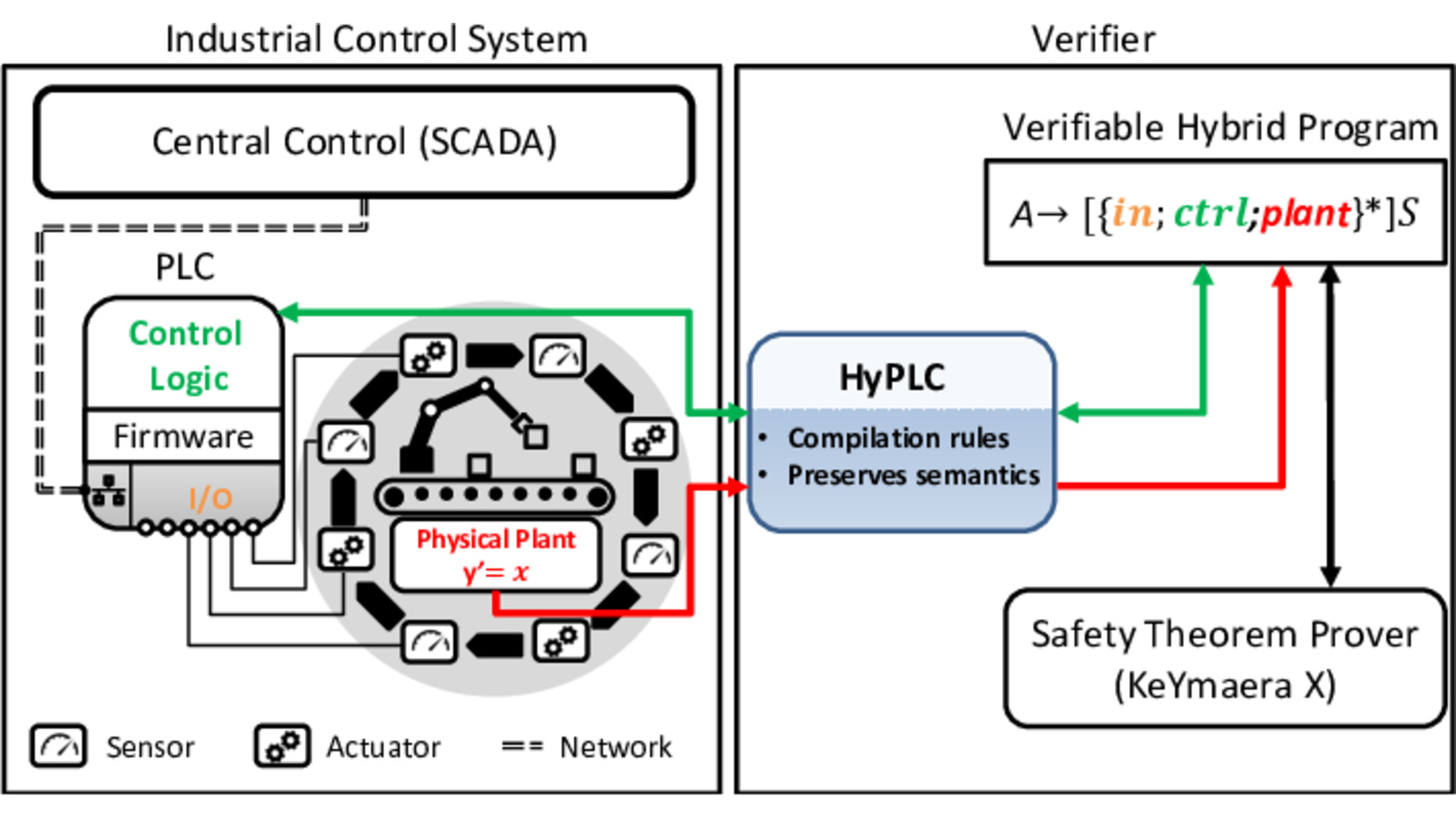
Project Overview
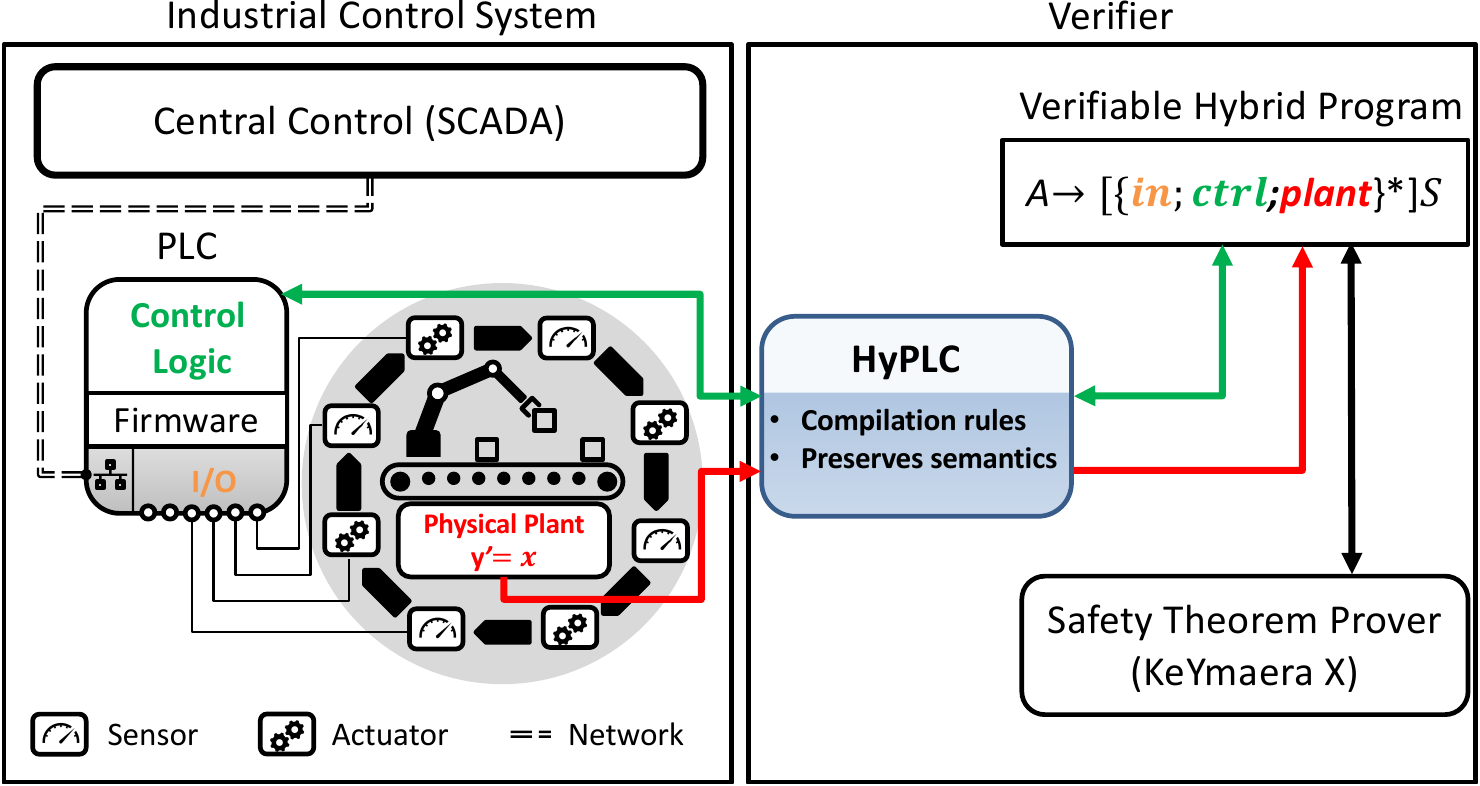
This project advances a full formal-methods workflow from high-level differential dynamic logic models to executable PLC controller logic, with explicit links that preserve safety guarantees across design and runtime.
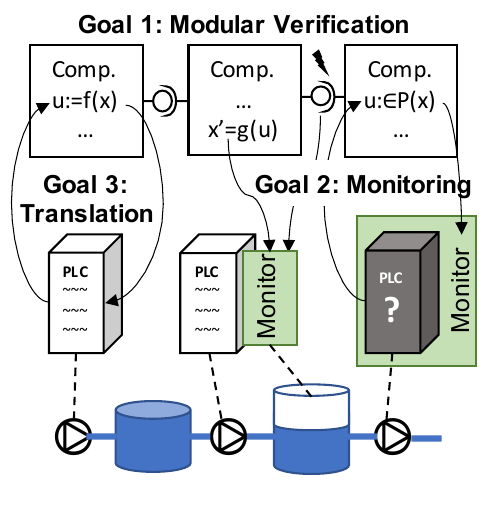
The public materials center on modular verification, monitor synthesis, and translation methods that connect model-level proofs with implementation artifacts used in realistic ICS settings.
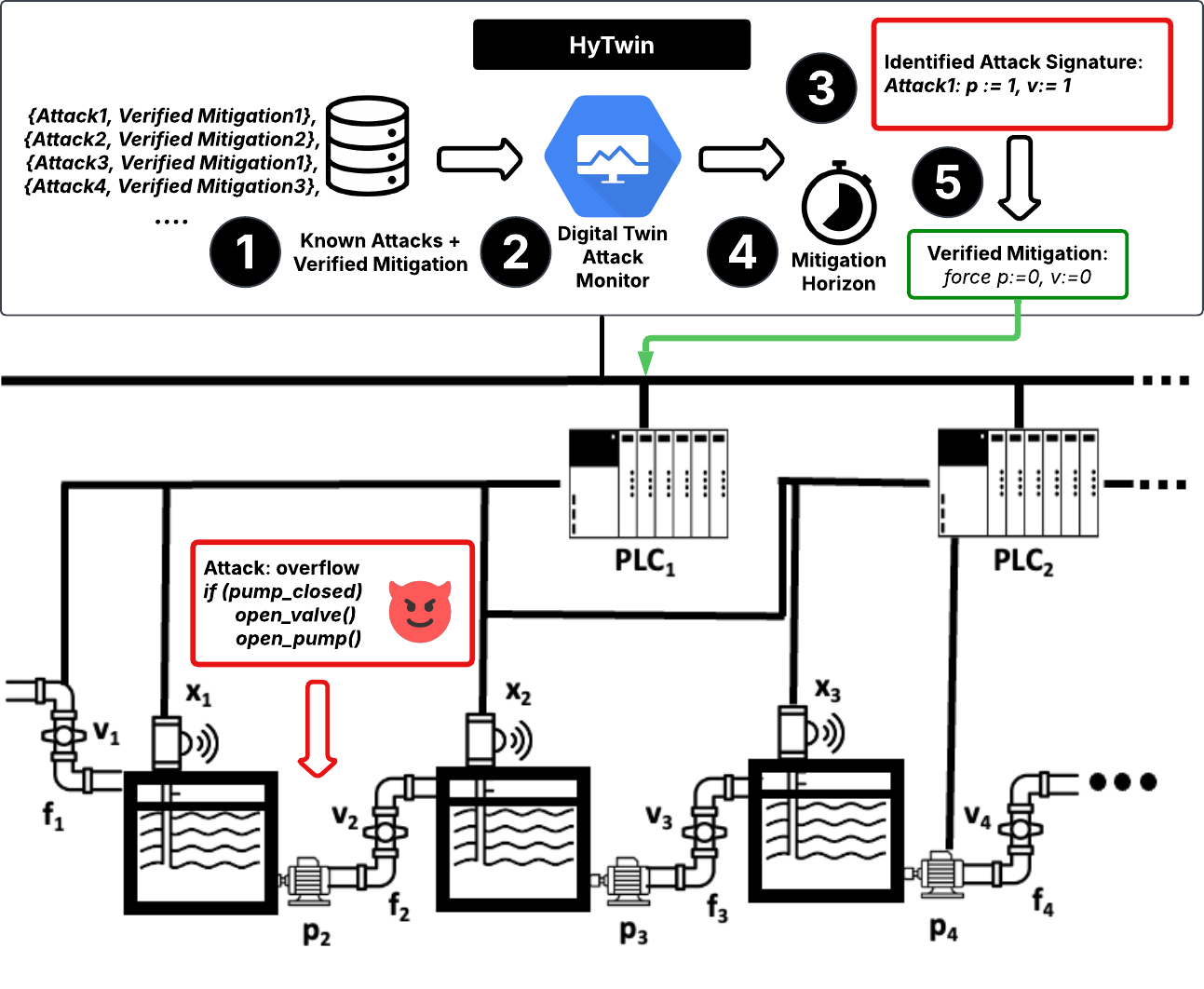
The work builds on and extends prior HyPLC efforts, and informs follow-on work such as HyTwin for digital-twin-based security interventions.
Key Capabilities
- Bidirectional translation between verified hybrid-program models and PLC control-logic structure
- Runtime monitor synthesis that checks model-to-runtime compliance
- Modular verification workflows for scalable ICS controller development
- Reproducible experiment and evaluation artifacts rooted in water-treatment-style ICS case studies
Example Use Cases
- Design-time verification of PLC control logic against hybrid-system safety requirements
- Runtime validation of assumptions to detect deviations that invalidate offline proofs
- Evaluation of resilient control behavior under representative cyber-physical perturbations
Project Figures
Selected Publications
HyPLC: Hybrid programmable logic controller program translation for verification
Luis Garcia, Stefan Mitsch, Andr{\'e} Platzer · Proceedings of the 10th ACM/IEEE International Conference on Cyber-Physical Systems (2019)
ICCPS 2019 Best Paper Award Honorable Mention
Jainta Paul, Stefan Mitsch, Luis Garcia · NASA Formal Methods Symposium (2025)
Research Themes
Project Details
Related Projects
SPHERE CPS Enclave: Reconfigurable Testbed for CPS
NSF Mid-Scale RI • 2024–2028
SPHERE CPS Enclave is a reconfigurable, remotely accessible industrial-control experimentation environment for repeatable and shareable cybersecurity studies spanning PLC logic, SCADA/HMI interaction, process telemetry, and configurable network behavior.
SMELL-CPS: Symbolic Math Expressions from Low-level Logic in Cyber-Physical Systems
DARPA • 2020–2021 (18 months)
SMELL-CPS developed methods to extract interpretable mathematical expressions and semantic structure from low-level CPS control binaries, enabling reverse engineering, assurance analysis, and downstream automated testing workflows.